
6/12 6/25 LSR - 10/12 10/25 LSR

All movements are hydraulic
All the machine's movements are controlled by a high-efficiency motor pump unit (driven by an inverter), located in the oil tank and easily inspectable.
Special machine plans
The original design of the machine plates allows the assembly of only the dies, thus significantly reducing the size and cost of the moulds.
Movements
The press is governed by two microprocessors that monitor and manage the movements, times and temperatures of the production cycle.
Proportional Hydraulics
Thanks to proportional hydraulics, the pressures during the cycle phases are managed and memorized by the machine.
Maximum security
CE certification.
Mold safety
Approaching in low pressure.
Color touch screen display
USB output and Ethernet connection (Modbus TCP)
Cooling Management
The amount of coolant flow at various points in the press can be adjusted using a flow meter.
Heating the mold
Thanks to the use of cartridge heating elements and the insertion of a thermocouple for each mold part (fixed and moving), it is possible to achieve a uniform temperature of the dies with minimal energy expenditure. Two mold temperature control zones are available on the machine and can be managed via the display. Maximum allowable temperature is 220°C. The machine plates are cooled.
Decentralized injection
The injection unit has two injection positions: one central and one 25 mm lower. In the case of a single impression, where central injection is not possible (for aesthetic reasons), the cavity can be kept central to the planes by injecting on one side.
-
8″ backlit LCD touch screen display
-
Vacuum function management in the mold
-
Cooled machine nozzle with pneumatic shutter for direct injection onto the workpiece
-
3 versions of use: 0.5kg premixed cartridge – 1kg mixer with dispenser (cartridges A and B) – 20kg mixer with dispenser (containers A and B)
-
10 different languages selectable
-
Pages can be easily consulted thanks to the multifunction keys
-
Quality control on 4 cycle parameters
-
PID temperature control
-
4 temperature control zones, with differentiated mould temperature regulation (fixed and mobile part)
-
Manages and stores over 1000 production cycles
-
USB output program backup
-
Ethernet connection: Modbus TCP
-
Pressure control with electronic transducer
-
Injection position and closure control with linear transducers
-
Proportional hydraulics
-
Soundproofed motor pump unit controlled by inverter
-
Euromap 67 card (option)
-
Savings in mold construction thanks to the machine die-holder plates
-
Low running costs – installed power 3kW – cooling approximately 120 l/h
-
Decentralized injection – 5 pistons from 3 to 15 cc with pressures from 2650 to 815 bar
-
Output for auxiliary control
-
Cooling circuit (6 zones)
-
Temperature tolerance band
-
Hydraulic extraction with extractor return control sensor
-
Jack management and air blowing
Advantages
Quality of the pieces produced
Low-cavity mold . Dimensional accuracy is easy to achieve. Thanks to the low hourly cost, competitive pricing is possible even with molds with just a few cavities.
Simple balancing cavity layout.
Homogeneous mold temperature . Thanks to the small mold size and the positioning of thermocouples (partly fixed and partly mobile) near the cavities.
Air-conditioned injection unit . Thanks to its compact size, the material present in the injection unit after mixing is just a few cubic centimeters. The injection unit, including the nozzle, is cooled. This ensures the integrity of the material even for very small weights.
Low production cost
Low power consumption. Only 3 kW of installed power, inverter for managing motor speed. In cycle, it consumes only 1.5 to 2.5 kW.
Reduced mold and material changeover times . Dies secured with two screws per side, centered on the machine tabletops. Material and color changes in approximately 150g.
Low consumption for mold heating. Mold dimensions reduced to just the dies, resulting in reduced time and energy needed to reach and maintain the correct mold temperature. Use of two cartridge heaters and a thermocouple for each mold half. Mold temperature control directly from the machine.
Low casting/part ratio . For single-cavity molds, direct injection onto the part thanks to the valve gate nozzle (standard). For multiple cavities, direct injection into the die results in a significant reduction in casting. Average casting weight for 4 cavities: 0.5g.
Production island in less than 1m² . Thanks to its compact size (1×0.6m), it is possible to have a complete production island (machine – refrigerator – mixer-doser, with 1l cartridges) in less than 1m².
Flexibility for high-volume production. By splitting production across multiple machines, in the event of a problem, only part of the production process is stopped. It's possible to produce batches of different colors simultaneously. Starting with small production runs, it's possible to scale up by replicating the machine/mold.
Modularity in mixing systems. Three different LSR mixing and loading systems are available: a 0.5 kg pre-mixed cartridge, a two-component mixer for 1 kg cartridges (A and B), and a two-component mixer for 20 kg containers. This allows us to meet requirements ranging from prototyping to large-scale production, while minimizing investment.
Low investment in the mold
Low-cavity molds . Thanks to the machine's low hourly cost (approximately €2 to €2.5/h), low production costs are possible even with low-cavity molds. Especially for technical items where cavity costs are high (use of slides, etc.), the savings in reducing the number of cavities leads to significant cost reductions.
Construction of the dies only . Thanks to the special concept we developed, using machine plates that act as mold holders, to produce with a Babyplast it is sufficient to construct only the dies, avoiding the use of mold holder plates.
Direct injection machine nozzle. Thanks to a special cooled machine nozzle and pneumatic needle valve, direct injection from the machine to the workpiece is possible.
Standardized mini plates. A line of standardized plates for Babyplast molds is available (produced by Meusburger) in various types of steel where only cavity construction is required. This allows for significant savings in mold construction time and costs.
Accessories

Pneumatic gate
C10012000 - Pneumatic mold guard. Complete with two-hand control for closing/opening and starting the machine cycle.

Scrap pieces
C10013300 - Pneumatic sorter for rejecting non-compliant parts. Installed on the "RB026SR" roller casting separator, it activates the machine's quality control system. For each cycle outside the set tolerance parameters, the pneumatic sorter will be activated, diverting the non-compliant parts from the casting.

Roller casting separator
RB027SR - Thanks to its small size (900x100mm) and ease of installation, it is possible to separate the pieces produced from the casting in a simple and economical way.
It can be installed on all Babyplast models.

Electrical panel
RB018QA - Auxiliary power panel - CE - controlled by the machine. If alarm occurs, it cuts off power to the auxiliaries.
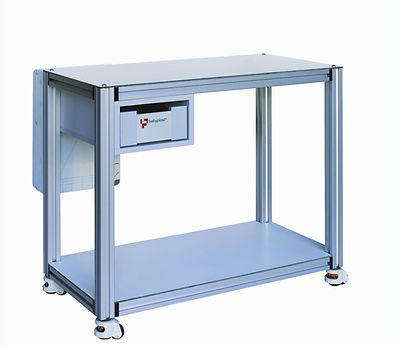
Bench
RB002BA - Mobile aluminum workbench with casters and integrated feet. Designed for a refrigerator and mold holder. 600x1000 h 900.

Air Blow
RB002BA - Mobile aluminum workbench with casters and integrated feet. Designed for a refrigerator and mold holder. 600x1000 h 900.

Hidraulic core pull
RB002BA - Mobile aluminum workbench with casters and integrated feet. Designed for a refrigerator and mold holder. 600x1000 h 900.

Picker
RB002BA - Mobile aluminum workbench with casters and integrated feet. Designed for a refrigerator and mold holder. 600x1000 h 900.
Configurations

Premix cartridge
Configuration operating with a 0.5 kg cartridge of pre-mixed material. It does not require a dosing device or mixer installed on the machine. This exclusive Babyplast solution allows those who already have a dosing mixer to load cartridges for use on Babyplast LSR to produce small batches or samples at a low cost.

Two-component dispenser 20 kg
Configuration with a mixer and two-component pneumatic dispenser (A and B) with 20 kg containers. Allows the use of Babyplast LSR with several days of operation. Optional colorant cartridge.